

A wooden or fabric reusable advent calendar is the rare Christmas purchase that gets cheaper every year you own it. Spend £30 on a good wooden one and by its third December it has already undercut the foil-and-chocolate sort you would otherwise have bought three times over — and there is nothing to put in the recycling on Christmas Eve. The catch is that “reusable” covers everything from an heirloom-grade wooden house to a felt pocket hanging you could run up yourself, so the trick is matching the calendar to your hallway, your children and your patience for filling twenty-four little drawers on the last night of November.
We have sorted the best below by the way people actually shop for them: wooden, fabric, fill-your-own, budget, and plastic-free. Every calendar below was listed on Amazon UK with a four-star-or-better review score when we last checked on 16 August 2026, and we re-check the page each season.
At a glance: our pick in every category
| Best for | Our pick | Price | |
|---|---|---|---|
| Best wooden | Spielwerk® Wooden Advent Calendar 2025 | Traditional Gift Mo… | View → | |
| Best fabric | HEITMANN DECO Felt Advent Calendar to Fill Yourself, Red Fab… | View → | |
| Best fill-your-own | Fill Your Own Advent Calendar, 24 Reusable Numbered Empty Draw… | View → | |
| Best under £20 | Décopatch Papier-Mâché Multi-Drawer Advent Calendar | View → | |
| Best plastic-free | Pioneer Effort Wooden Advent Calendar House with Drawers & L… | View → |
How to choose a reusable advent calendar
Four things decide whether a reusable calendar earns its place in the loft. Settle these and the choice more or less makes itself.
Drawers, doors or pockets? Wooden calendars with drawers or little doors are the sturdiest and the handsomest on a mantelpiece, but the compartments are small — think a single chocolate, a folded note, a Lego minifigure, not a satsuma. Fabric pockets and hanging bunting hold more and tuck away flat in January, at the cost of looking less like furniture. Fill-your-own boxes and crates sit between the two and suit a family that likes to wrap each day.
How big are the compartments? This is the question nobody asks until December the first. If you are filling for several children, measure against what you actually intend to use — a chocolate coin and a wrapped sweet need very different doors. Larger fabric pockets win for bulky or homemade treats.
What is it made of, and will it last? Solid wood and proper cotton or felt survive being packed away and dragged out twenty times; thin MDF, glued card and printed plastic do not. A calendar you reuse for a decade is both the greener choice and, quietly, the cheaper one — the cost-per-Christmas of a £35 wooden calendar over ten years is well under what a single filled supermarket calendar costs today.
Filled, or fill-your-own? Almost every calendar on this page is the fill-your-own sort — that is rather the point of reusable — which means the contents, and the cost of them, are yours to control. That is a feature, not a chore: it is the difference between twenty-four identical chocolates and twenty-four small thoughts.
Best wooden reusable advent calendars
The heirloom choice, and the one most likely to outlive the children it was bought for. Wooden calendars — drawers, doors, little houses, the odd LED-lit village — look the part on a hall table and pack down hard enough to survive the loft. The compartments are small, so they suit chocolates, coins and tiny treasures rather than bulky gifts.
 Spielwerk® Wooden Advent Calendar 2025 | Traditional Gift Mountain with 24-Day Countdown | Holiday Décor | ReusableView on Amazon →


Best fabric & hanging advent calendars
Softer, roomier and kinder to small hands. Fabric calendars — cotton pockets, felt hangings, hessian bunting — hold more than a wooden drawer ever will, which matters if you are filling for several children or favour homemade treats. They hang on a wall or banister, then fold away flat in a drawer come January.
 HEITMANN DECO Felt Advent Calendar to Fill Yourself, Red Fabric, 39 x 23 cmView on Amazon →


Best fill-your-own & refillable advent calendars
For the household that wants full control of what goes in. These are the calendars sold empty by design — drawers, crates and numbered boxes waiting for your own chocolates, notes and small things. They are the most flexible of all, and the most personal: twenty-four little decisions rather than one trip down the chocolate aisle.
 Fill Your Own Advent Calendar, 24 Reusable Numbered Empty Drawers for Christmas Countdown (Sky Blue)View on Amazon →


Best budget reusable advent calendars (under £20)
Reusable need not mean expensive. Under £20 you will still find a calendar built to come out again next year — and because you fill it yourself, the running cost is whatever you decide a bag of chocolate coins should be. Taste and thrift are not opposites here.


 Rayher Papier-Mâché Cupboard with 24 Pull-Out Drawers for DIY Fill-Your-Own Advent CalendarView on Amazon →


Best plastic-free & eco advent calendars
If the whole appeal is keeping foil and single-use plastic out of the Christmas Eve bin, these are the ones to look at — solid wood and natural fabric, made to be used until they wear out rather than thrown away in January. The greenest advent calendar is simply the one you already own; the second greenest is one of these. One caveat worth reading the listing for: some wooden calendars include LED lights, batteries, glitter or plastic drawer runners, so “wooden” does not automatically mean plastic-free. Check the product description if that matters to you.
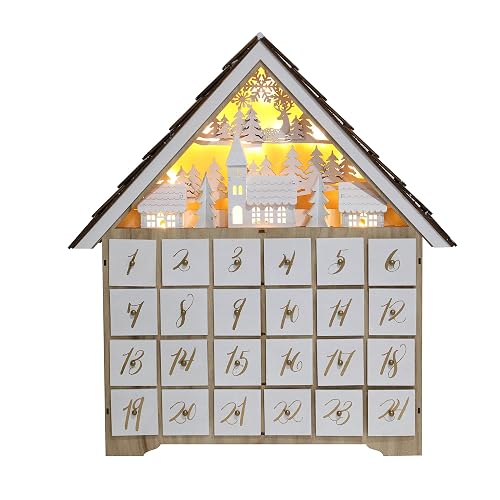 Pioneer Effort Wooden Advent Calendar House with Drawers & LED Lights, Reusable Village SceneView on Amazon →


What to put inside — for grown-ups, children and a careful budget
An empty calendar on the 30th of November can feel like a small panic. It needn’t. The contents matter far less than the ritual, and the best fillers are cheap, tiny and a little bit personal.
For children
A chocolate coin or two, a Lego minifigure, hair clips, a rubber, a marble, a folded note with the day’s plan on it (“tonight we put the tree up”), a single felt-tip in a new colour, a clementine for the larger pockets. The note-a-day approach — a tiny activity or kindness rather than a thing — is the one parents tell us their children remember.
For grown-ups
A square of good dark chocolate, a single fancy tea bag, a miniature, a lottery scratch card, a folded voucher for “one lie-in, redeemable in January”. A calendar refilled for a partner is a fortnight of small attention that costs very little and reads as a great deal.
On a budget
You do not need to spend a fortune, and the loveliest versions often cost least. A £3 bag of chocolate coins covers most of December for one child; the supermarket bakery aisle and the pound shop between them will fill a calendar for the price of a single posh one. Best of all are the free fillers — the handwritten notes, the “today we make mince pies” cards — which are the bits that actually get kept.
Reusable advent calendars: your questions answered
How do you store a reusable advent calendar so it lasts?
Empty it completely first — any stray chocolate or crumb is an invitation to the loft’s wildlife — and give it a wipe or a shake out. Store a wooden calendar flat or upright in a lidded box so the little doors and drawers cannot warp or snap, ideally with a silica gel sachet to keep damp off the wood. Fold fabric calendars loosely rather than cramming them, and keep them out of direct sunlight between Decembers so the colours do not fade. Looked after this way, a good wooden or cotton calendar will see out fifteen Christmases or more.
Are reusable advent calendars actually worth it?
Financially, yes, and quickly. A £30 wooden calendar reused for ten years works out at £3 a Christmas before you add anything to it — less than a single filled supermarket calendar — and you control what goes inside. It is also the greener choice, with nothing to recycle on the 25th. The one honest caveat is the few minutes spent filling it each year; most families find that part is rather the point.
What should I fill a reusable advent calendar with?
For children: chocolate coins, a Lego minifigure, hair clips, a marble, a new felt-tip, or a folded note with the day’s plan on it. For grown-ups: a square of good chocolate, a fancy tea bag, a miniature, a scratch card, or a voucher for a January lie-in. The compartments are usually small, so think tiny and personal rather than bulky — and a handful of free, handwritten “today we…” notes are the bits that actually get kept.
What is the difference between a wooden and a fabric advent calendar?
Wooden calendars look the part on a mantelpiece and are the sturdiest for long-term reuse, but the drawers and doors are small — chocolates and coins, not satsumas. Fabric calendars (cotton pockets, felt hangings) hold more, are softer for small hands, and fold away flat in January, but they read as decoration rather than furniture. Choose wood for looks and longevity, fabric for capacity and storage.
Can you personalise a reusable advent calendar?
Many fabric and wooden calendars are sold plain precisely so you can — add a name or initials, or simply make the contents the personal part. A calendar refilled by hand each year, with notes and small thoughts chosen for the person opening it, is about as personalised as a gift gets, and costs almost nothing to make so.
More from Christmas Countdown
- The Christmas to-do lists — our month-by-month planning hub
- Gifts for cooks & food lovers
- Lego gifts for every kind of builder — ideal advent-calendar fillers


0 Comments